


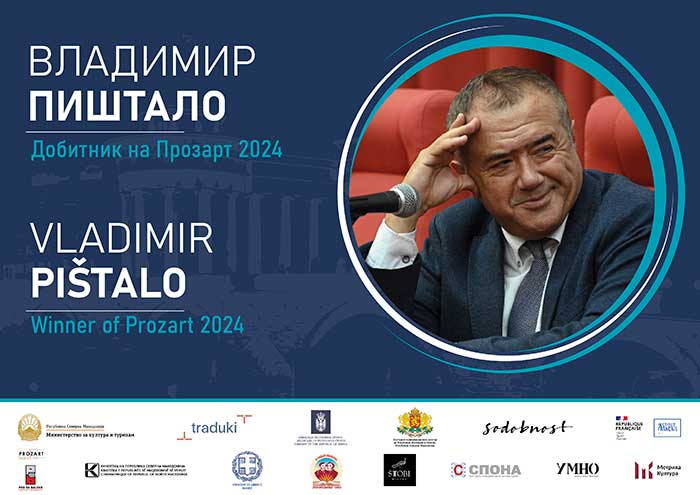
VLADIMIR PIŠTALO
Acceptance of the Prozart Award 2024 speech
Ladies and gentlemen, dear colleagues:
I always come to Skopje with love. After the breakup of Yugoslavia, this may not sound like a commonly used statement. After brotherhood-and-unity had gone out of fashion, we should perhaps talk about neighborly respect. Nevertheless, I still come here with love. One of the chief reasons is that my father, who was the director of the National library of Bosnia and Herzegovina, spent a year in Sarajevo, under the siege. I was not sure whether I was going ever to see him again. When he came out, he went to Skopje. I met him here for the first time. Many Macedonian friends helped me back them, most of all Sašo Prokopiev. Several years before, I had gone to Štip with Sašo. That was when I first heard a waltz from Štip, Razbolela se Lenka Pingova, and tried pastrmajlija. These are obviously not very intellectual subjects. But they are certainly emotional.
This is an occasion to remember some other friends who are no longer with us. I am thinking of Ljilja Dirjan and Bogomil Djuzel. Bogomil, a great poet, told me how he cured his sinus pain with bioenergy of his own hands. Ljilja has taught me ,and a number of other writers from the region, the meaning of friendship. She was multitalented--a friend, a writer and a chef. Ljilja used to make Imam has fainted and a number of other peculiar dishes, some of which she herself invented, for us. Once we went as a group to the Ohrid lake and spent several days there. Ivo Andrić used to call it svetlo ohridsko jezero--the bright Ohrid lake. So I went swimming and, under the church of St. Jovan Kaneo, found myself in the midst of some floating garbage. I felt weird and then I realized that these were all rose petals. Probably some wedding party threw them, ritualistically, into the lake. We should be very careful to discern between garbage and roses.
A friend told me that of all his travels he profits the most from the travels through the Balkan countries. My books have been translated into all Balkan languages. I tend to follow them. I get a lot from meeting the other sides of the familiar. I define my Balkans as a space between Venice and Constantinople. In both Venice and Istanbul one can take a boat as if it were a bus. Venice itself is a city neither on the sea nor on the firm ground, neither in the past nor in the present, neither in reality nor in imagination, neither in the East nor in the West. It has multiple nature. In that it is the symbol of the Balkans. Borislav Pekić called that a centaur-like state of being. Some characters in his Golden Fleece want to change from a centaur to a horse. On a more noble side of the same craving for simplification and purity, we can imagine a centaur who wants to become a human being, to become exclusively rational. Good luck with that.
The Balkan Peninsula stretches between two most beautiful and most cosmopolitan cities that have defined European history: Venice and Constantinople. (As an old Serbian proverb says, Venice, a rose unfurled, and Constantinople, the center of the world.) It is a region of syncretic cultures. Its symbol is the bridge. According to the Nobel prize-winner Ivo Andrić, the bridge is a place where man came across an obstacle but didn’t stop…because all our hope is always on the other side.
Right across the Balkans, there ran a line that first divided the Roman Empire, and then Christianity, into its eastern and western parts. During Antiquity, they called the Balkans Catena Mundi, which could be translated as the Artery of the World. It gives its East to the West, and its West to the East,
Frequently, the Balkan peoples have no clue about each other. They are like drawings made one over the other which, when the viewer steps back, create another image. They pretend to believe in different gods, even though they all believe in a single god called Passion.
The inhabitants of the Iberian Peninsula pride themselves of being culturally diverse. The same applies to the Balkans. But Muslims and Jews were expelled from Spain. In the Balkans, people kept living side by side.
According to Emanuel Kant, good will is the only truly good thing in the world. Some time ago I had an honor to visit Ismail Kadare and his charming wife Helena in their house in Drač. I was happy when I did it and I am even happier to have done it now. With great joy I accept this award associated with his name, among others. Both Ismail Kadare and Georgi Gospodinov refused to write locally and exotically. Humbly, I fully agree with them.
The ditty about the clash between the Great Spirit of the East and the
Great Spirit of the West, composed in the name of reason, does not sing to me. It never has. As a writer I don’t believe in magical geography. The Balkans, where I was born, is a seam. It is an antenna. It is a cat’s whisker. To be born in a “bad place” is to be born in a good place. Men from the border
is familiar with the “prenatal darkness” of Orthodox churches. They are familiar with Islamic adoration of light and water and with the Latin obsession with clocks and bells. The Balkans is a privileged observation platform. No one needs explain Turkish or Russian cultures to us. Or Italian, or Central European, for that matter...
What West? What East?